


RPG’s are a Conversation?
Are RPGs a conversation, really? The short answer is yes, but in the many years (over 30) that I have been having conversations about this conversation, the topic has been able to race off in a lot of different directions. While that has been good for my personal experience in thinking about the abstract and concrete aspects of the topic, it has also demonstrated that the whole idea can be slippery and, of course, even small parts of it can strike some gamers as being useless. What I have found is that coming to terms with this idea not only helps with playing RPGs for enjoyment, it helps with understanding what they are, why a game works well in some contexts but not others, what is and is not worthy of your time as a participant, how to match games and interests, and even for playing them for other purposes, such as education. Not bad for a throwaway line like, “RPGs are a conversation,” right?
I think people have accepted the notion that RPGs are hard to understand, and some might even find that notion to be appealing. Such mysteries boost the cachet of a less-common pastime. Like many before and after me, I found as a newcomer to RPGs that part of my fun was assessing how to do them well, but also it was a part of my nature. I couldn’t look away from the patterns involved and “just play.” It was necessary to talk about and work with them.
With that sort of outlook some things stand out quickly. One added benefit that I had, though it did not seem like one at the time, was being forced into awkard and inconvenient times, durations, and places to play by the Satanic Panic. I had a lot of variations in play to assess. One detail I recognized early and then could not unsee is that essentially, playing an RPG is a type of conversation, defined by specific elements in unspecific mixtures created by transitory and more enduring (intransitory) things. Are RPGs a conversation? Catchy phrases are great for getting attention, but then where does the idea go? For me, the realization about how verbal communication constrains us as gamers first took me into two parallel investigations. One was into what, how, and then if my fellow players imagined. The other was to complete the thought that RPGs are a conversation with an exploration of those constraints: What is this particular conversation which is an RPG about this time and how it is about that this time, with this group, in this situation, while played this way?
Putting in some time thinking through the idea and discussing it helps with its slipperiness. Dealing with the dismissive, assumptive, and presumptive reactions, and the misinterpretations, takes more interaction. That’s what videos like the ones below, the numerous APs on the Runeslinger YouTube channel, and posts like this one are for. The abstraction of an unwieldy or uncooperative idea is our way of framing, comprehending, and then being able to make use of it. The abstraction of the catchy phrase, which I was thrilled to find a mirror and support for much later in life when I explored the ideas of Marshall McLuhan, is insufficient if we wish to really learn its meaning and make use of it. We have to then dive into the practical and the specific. The journey forward requires looking around and backward as well. The big picture view exposes the contexts of the full range of possibilities. Changing and assessing the consequences of those changes on the specifics helps us understand what we do when we play and why that matters in more immediately useful ways. This in turn helps to clarify that view from afar. That in turn gives us more to consider when we zoom back in on the specifics…
Let’s look at two proof of concept examples. One from RPGs as my hobby, and one from RPGs as I use them in education and skill training. Don’t worry, I will keep them brief.
Gaming Online
Let’s start with the fun. I was an early adopter of playing online and in the beginning underneath the thrill of being able to video conference and game easily with handpicked groups, there were some (and continue to be) intriguing limitations on the experience. My first major reaction to this sort of play was to feel far more tired after far less play and that came coupled with a sense of isolation. I have heard this same complaint echoed from other groups over the years. As they feel it too and reported it independently of each other before it became a stock line to repeat unthinkingly, I felt confident in noting this reaction as a real one with a broad base of people for whom it was relevant.
Taking my customary step back to look at our play, I noted it wasn’t the system, crunch, props, or mics or the lo-res cameras, or whatever quirks of screen usage the software might have that were tiring me out, it was the constant searching for more detail from the players. While I could hear their words and get their tone, there was much about their facial expression that was missing and for most participants none of their body language was in evidence. Not being in the room with them meant that a lot of the important emotional and intensity cues we get instinctually in face-to-face conversation was absent. If I intended to keep playing online, this needed to be addressed. The fix, put in that context of what elements of communication had been compromised, was simple. I asked the players to sit farther from the camera to show more of their body language. I also asked people to do their best to avoid speaking over each other. I didn’t do this latter part in response to a still-present weakness in how audio is processed in most programs, I did it to ease the burden of and emphasize the importance of actively listening to each other.
The improvement was immediate. It wasn’t a perfect fix and we still tend to play for no more than 3hrs, but I have more fun during the sessions, I have more energy to invest in my roles and responsibilities in play, and at the end of the session I am not drained.
Over time, I also experimented with the return on investment for things like learning fluidity with a VTT or working out my own system of quickly and effectively sharing things like props or map views. As the need for such things varies with the game being played and the manner in which we intend to play it, this was a less important exploration and to meet my own personal goals in play is an easy thing to cut completely from online play. While a picture can be worth 1000 words, a moment of immersive imagination is worth the world.
Gaming in the classroom
I have been using roleplay in classrooms for almost thirty years and for all sorts of reasons. Mainly this is for drilling skills the student would like to be able to devote less attention to when in the thick of things, and for communicating a depth of context and culture which just talking about it would be less effective at conveying.
In the classroom we can remove, rewrite, or replace barriers of age, culture, confidence, and perceived creativity through roleplay. As language practice and instruction this allows the participant to immerse themselves in a situation as someone else, know what is expected of them in that situation, internalize its cues, drives, and spoken and unspoken rules, then practice all of that on equal footing with others who need to master this skill and awareness, too. It’s freeing and it impacts the understanding of the student on more levels than just memory or their intellect.
Where this process has affected me more deeply, however, is when I use it to help open the minds of students to their own creativity and imagination, while helping them practice the tools for sharing it with others. By using roleplay more directly, with all of its dice, rules, procedures, and fun things like stationery supplies and graph paper, time and time again the participants find themselves not only being imaginative and creative, but desiring to do be so as often as they can. By distracting them with the process and procedures while in the act of creation long enough to get them started, then slowly revealing through presentation, discussion, and writing what it is they have created and that they are indeed the source of these great ideas we obviate the false conceptions and fears they have about their own abilities or lack of ability and let them tap into it directly by ‘just following orders.’
This has let me run wickedly invested debate squads, create short-story collections and artwork, and see people progress on to great jobs in advertising and entertainment production that they might never have applied for. If I had simply tried to convince them in a normal conversation about their potential and handed them a prompt and the time to “be creative” none of us would have accomplished anything. As a gamer, I was intimately aware of how much creativity it can require, how it can stimulate thought, confidence, and imagination, and how effortless it can be to connect and share it all with people. This was the obvious tool I needed. All I had to do was assess the specific need of a particular group and shape the game that would let them find those abilities in themselves before they even knew what was going on.
You are a gamer. You know exactly the feeling I mean.
Roleplaying games are communication. The thing is, what can we communicate? What do we communicate? Do we need to change how we do it? Why, and to what end?
So…?
Okay, so now it’s 2025 and I have played with people from all around the world, in all sorts of places, in all sorts of configurations and levels of comfort, to a wide variety of outcomes. I have played just for fun and camaraderie. I have played for pathos, I have played for tactics, and for years long strategies. I have played in character and out of character and somewhere in between. I have played multiple characters in sequence and all at once, for one-shots and for years-long campaigns. I have played to educate and played to build confidence or spark self-discovery. I have played a lot in a lot of ways with a lot of people and it has been sustaining in ways that no other hobby activity has come close to. Through it all, I have been having or trying to have conversations about “the conversation” with all of these groups in one form or another, to varying depths, since the colorfully-bleak ending years of the hairsprayed 80s. If you look for it here, in the podcast, and the YouTube channel, you can see it or at least the fruit of those labors.
Recently, one of the people I enjoy speaking about and playing RPGs with, Brian Gregory, has restarted his Stochastic Agency YouTube channel and took inspiration from this line of discussion to start talking about the specifics of the RPG conversation and that motivated me to start talking about the abstract end of that topic more widely. Brian’s video can be found >>HERE<<.
Since his video and my two (above) have come out on the subject, in addition to interacting with viewers in the comments and in private chats, two different panels were assembled to explore some core ideas. One panel has been recorded and is in the editing queue and the other is set to be recorded next week. Both sets of participants for these panels were kind enough to – in isolation from each other – address some questions I prepared to establish some background for a panel discussion on the topic. I find this facilitates focus when a topic is broad and able to contain numerous lengthy tangents and avenues of exploration.
Once the two panels had submitted their responses, I collected them into two videos to share between the two groups prior to the discussions. This let us get foundational ideas and reactions out in a controlled and uninterrupted way that each participant could take their time to absorb about themselves and each other participant. As added perks, it also lets us get back into the zone quickly if a delay interferes with a panel, and lets us evaluate the overall effect of the discussions on our ideas. It’s very interesting what came from these recorded responses to the set of questions and as the panel discussions are each about an hour in length I have been evaluating how to include them for those who watch the panels. I have decided to append them to the end of both panels and provide separate links in the YouTube description box, but I also want to involve you, Dear Readers. To begin, let’s look at the questions!
Because communication and everything that makes us us interact in interesting ways, I presented the participants with three versions of the same questions so that the chance of each participant understanding each prompt the same way could be magnified and each person could gravitate toward a question format which worked better for them. Here they are:
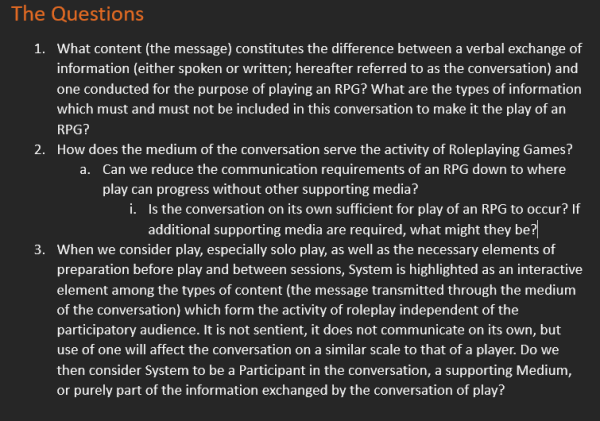

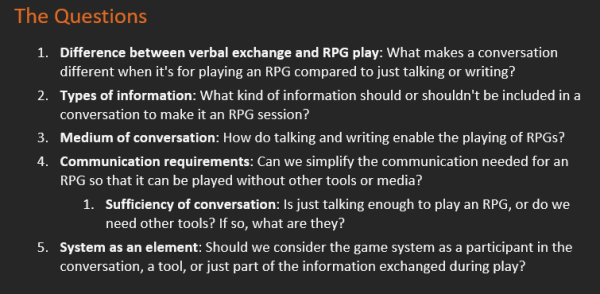
Read the questions over. Watch the videos shared above. Think about your own play experiences and what you have learned are your best practices and best things to avoid. Consider all of this from the point of view of who we communicate with, what we say, when we say it, where other forms of communication need to be involved or should not be involved, why you play the games you do with the people you do in the way you do, and how you might make that better (or worse). If you would like to share your responses with me here, or the other ways to contact me, such as e-mail (runescastshadows AT gmail) or an audio message via the Casting Shadows speakpipe, I would really enjoy that. Who knows where that conversation might lead?
Are you curious about who the participant are and what they said in response to these questions? The participants certainly were. None of them had a complete picture of who was involved and none got to listen to the others’ answers until all had been recorded. I find a lot of value in that. To that end, I will not be providing links to their responses just yet. I want to give you time to think and get in touch, Dear Reader~
Comments
7 Responses to “RPG’s are a Conversation?”Trackbacks
Check out what others are saying...-
[…] You can read all about them in THIS POST, and about how the plan was executed in THIS EARLIER POST. […]
-
[…] do those conceptions, and the dynamics of interest and ability within the group have us shaping the conversation which is the medium of […]
-
[…] but these examples make a strong start in establishing a more stable view of what goes on within the conversation that is play and how much variation can exist even within a single […]


 Casting Shadows
We did have fun with the panel, and the follow-up questions used in it were solid additions to the ones originally asked. There is still so much to discuss and many directions for this topic.
We have only just begun~
I tried to “Like” this post, but WP keeps undoing the click. So, know that I “Like” this.
Thanks for letting me know~