


Rivers of London: A Who’s Who of Lurkers, Workers, Hangers-on, and Ne’er-do-wells~
This is part five of what I thought might be a three part series on The Rivers of London novels by Ben Aaronovitch and its enchanting roleplaying game from Chaosium. In part one, we gave a shamelessly quick overview of the books and of the game. In part two, we surveyed the first three novels with a blink-and-you’ll-miss-it callousness. In the third installment, we touched on the five current novellas and their key differences from the novels with the special care and nonchalant casualness of a certain Mr. Palmer when lying. In our fourth outing on this subject we returned to the novels and brutally avoided spoilers the way some architects avoid loveliness. In this post, we will once again divert our attention from the books to talk to an insufficient degree about some of the amazing characters who fill the moments of levity, of drama, of fear, and of profundity which set this series apart from the others in its category on the shelves of Waterstones and the few surviving bookstores like it in this blighted digital age.
Our Who’s Who:
Before you get all excited, for whatever reason you might get excited about what is likely to be all-too-brief and possibly-hyphenated character sketches from the novels, we won’t be looking at the main characters. Not him, her, that other guy, and certainly not the Detective Chief Inspector, nor the Detective Chief Inspector you thought I meant. Not even Stephanopoulos, who is in my top two favorite mundane characters in the series and in my top 5 of all the characters in the series. So, if we are not going to talk about her, or any of those others, who is left?
That’s a good question, but perhaps not for the typical reason a reader, dear or otherwise, might ask it.
We are going to look at what I am going to call a lurker, a worker, a hanger-on, and a ne’er-do-well because I am full of the quirky power of an apple crisp forged from the faintest traces of imprinted memory that would make both Molly and Jamie Oliver gasp with delight. Who are they, you might ask, and wonder why I might label them so? They are four characters out of hundreds in the series who show us more directly what Peter’s cheeky banter, optimism, and flare for storytelling generally hide from us when he speaks of his associates and fellow stars of the series. There are four characters who we get to spend some important time with during the series, but who are a step or two back from the front lines. They are insistent characters. They have distinct voices, and their visits leave a mark. They show us more of the world than Peter might want us to see, and so, they are the focus of this installment of these blog posts.
Let’s go see why in a little more detail.
Character 1: Zach Palmer
We first meet Zach in Whispers Under Ground, and he zooms in and out of focus in subsequent novels like the transient couch-surfer he seems compelled to be. If I were to describe Zach in a single word it would be liar, but I would say it with a sort of smile to let you know I didn’t take it personally. Zach has such a bizarre and convoluted relationship with the truth that is might be worth a series of its own.
Zach is a character that Peter cannot help but like and that teaches us a fair bit about Peter and about Zach right in the moment we realize it. Each frustrates the other, but at the same time they simply get along.
More interestingly, Zach is loyal beyond service to his own needs, he is capable of romance and sacrifice, he is in touch with his capacity for joy, and he is surprisingly intolerant of self-deception, his own or others’.
He is a character largely presented for laughs, and gets them both in text and in the audio versions of the novels. He is capable of moving between the mundane world and the demi-monde, and gets by on odd-jobs, crashing with mates, and being useful in the right times and places.
What is under that veneer of comedy and the stereotypical street contact in a police procedural?
We don’t really know, of course. Peter never tells us, but he can’t help but hint. What is the life of a man in modern London who is incapable of settling down when he has the means to do so, and who is just different enough from others that he is constantly being barred, banned, or booted from all sorts of different places? What is the life of a figure in the demi-monde who is just demonstrably special and strange enough to know he has been set apart from the mundane people of the world, but who is at the same time considered to be among the lowest of those who are special? What was it like to grow up a step removed from the group already a step removed, on his own, without support, and without respect? I suspect that there were very hard lessons learned very quickly on some very cold streets.
Where we might think we are looking at a grifter, we might actually be looking at a survivor, both of the world and of himself.
Oddly, perhaps, when I look at Zach, I have to wonder if he might have had a happier childhood than Peter. Not easier, mind you, but possibly happier.
Character 2: Peter’s Mom
Peter’s Mom has a name, but let’s call her Peter’s Mom for the conspiratorial, behind-her-back feel of it. Afterall, we might not be big enough to escape a beating. Yes, you read that right. Peter’s Mom is a very nuanced character for one standing in the second tier of figures in the series. She is often on Peter’s mind comparatively speaking, and she is present or responsible for some powerful and significant scenes. For example, she changes the course of Moon Over Soho with the fury of a lion protecting her cub. Similarly, she changes the course of Amongst Our Weapons with fierce tears and a mother’s love. Interestingly also, no matter how much Peter has disappointed her, or how much he fears he has done so, she is there with buckets of rice and all the strangest parts of the cow to ensure he keeps his strength up. The door is open to him at any time.
However, perhaps the one line we hear from Peter more than any other in describing his mother, is that he is still not so big that she cannot beat him.
We don’t know what kind of beatings. We don’t know that he was abused physically. We can suspect with good evidence that he was given corporal punishment for stepping out of line and that is the way that his mother was taught to raise children, no doubt by being raised so herself.
We can also feel that being taken into the Folly and being shown how his particular outlook and talents are strengths in that role is a sort of turning point for Peter and his relationship with both of his parents – his mother in particular. In the first book, he reluctantly goes home to them in a time of trouble, but over the course of the series, their bond strengthens and some things begin to heal.
There are many things about Peter’s Mom that are played for humor or exaggerated, but I think it is important to imagine the woman who kept the family together while drugs, addiction, and failure kept threatening to tear it apart. I think it is important to imagine the woman, very poor and working very hard, choosing to send anything and everything not nailed down to less-fortunate family in Sierra Leone – no matter the cost to her comfort, or her son’s. I think it is important to remember a woman who holds herself upright with self-respect even in the face of what the series is unafraid to call goddesses.
The world that Peter paints for us is full of humor, love, friendship, and a sort of lucky success. Between the words, however, figures like his mother show us more nuance, a little bit of darkness and pain, and the reason to look deeper.
Character 3: David Carey
We meet David Carey around the same time we meet the truth-artist Zachary Palmer in Whispers Under Ground. David, through no fault of his own ends up spending more time with Peter and the types of cases that come to be known as “Falcon” than he ever thought he would.
David is a decent cop. He is a regular fellow. He is not one of those on the fast-track, but neither is he distrusted or looked down on. He is expected to be a member of any team, be able to walk into any home, and whatever else goes awry, get the job done.
Peter is somewhat reticent about David, even at the beginning of their working relationship. Peter is, of course, relating these tales to us from some point after the events have ended – sometimes quite a while afterward. What this tells me is that even after time has allowed the emotions to fade, there are still things which Peter does not want to look at too closely in a sort of, “There but for the grace of God go I,” way. Perhaps it’s the bounty of one or more Rivers, but you catch my drift.
David Carey has good cop written all over him, and by all rights should have a good and lengthy career. Right?
That’s when it hits you, doesn’t it? When you add in the Folly, what are the odds that any of them will make it out unscarred? The mental and physical damage starts piling up from the very first novel. The likeable people you associate with might not survive knowing you. It’s not the sort of thing to ignore.
For all the laughs and thrills, this is a dark thread we get reminded of in subtle ways, like in the 1/3 of a desk that belongs to David Carey.
Character 4: Reynard Fossman
Pretty much everyone can find something to like in the characters we have touched on so far. This last one, however, is filth. Not in the way that Peter is a member of the ‘the Filth’, but in that stained-soul, vile way reserved for the bad people whose preference for their own satisfaction confuses them so much that they think they are not villains, but champions of virtue. It should not surprise us too much when so many people like that find their way into circles of power and are inevitably recognized as pedophiles. Yet, to our shame, we allow them to both persist and profit from their sins. When caught and shown the true error of their ways, though they repent in a manner of speaking, they manage to do so in a guiltless way which undermines the whole thing. No redeemable qualities.
We first meet this character chatting up the underaged Abigail at the Spring Court of the Old Man of the River and Mama Thames in Broken Homes. We have the distinct displeasure of meeting him again under more stressful and less comfortable circumstances later on.
Not nearly so nuanced as the previous three characters, he is here to remind us that Peter sometimes shows us what something or someone really is – though at times, he doesn’t have the words to really express it. He is too young and too inexperienced to truly comprehend some ugly truths, and often he is too polite to go on about them. While the magical world is full of lovely and kind people; full of clever and shy people; full of people who want to work, keep their heads down and be left to themselves; and full of dreamers and protectors in equal measure, there is still evil among them and it can just as often walk with no shame as cover itself in a flamboyant mask and spell to be famously anonymous in villainy.
Reynard wants you to see him sin, and he wants you to know that there is nothing you can do about it. It’s that lie that keeps him safe. Him, and all the cowardly predators just like him.
The Game
.
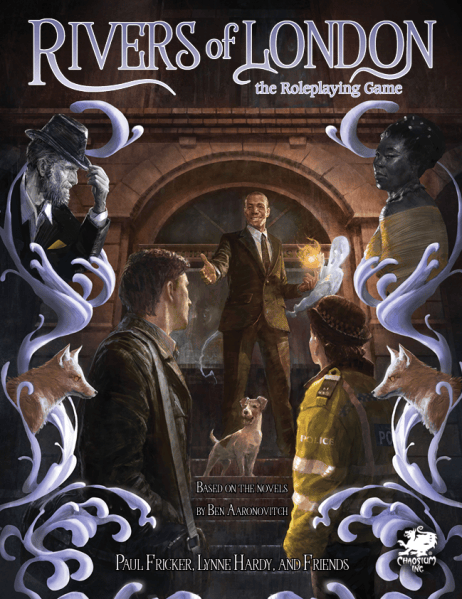
Chapter 6 of Rivers of London: The Roleplaying Game gives us quite an extensive selection of characters from the novels in its cheekily named Rogues Gallery. Can you imagine calling Beverley a rogue? Oxley and Postmartin, surely, but Bev? It’s shocking.
That effrontery aside, that chapter covers a lot of ground in terms of giving us a clear snapshot of character behavior and a good insight into how Peter might describe them to a new associate at first. He has a useful mix of withholding and oversharing that is ideal for a collection of RPG characters presented to the GM for portrayal if desired.
Peter has more to tell us, however. It’s often between the lines in the books or in what seems at first to be a throwaway line meant for humor. Humor can contain a lot of pain and anger and keep it veiled behind a big smile. It can also contain a lot of love and radiate it in the light of a similar smile. It’s there in the friendship with Zach. It’s there in the vague descriptions of childhood and of Lego and the deep descriptions of gallons of soup. It’s there in the brevity about Carey and the quick camaraderie they felt as police. It’s there in the disgust about Reynard which hints at so much more.
There is depth to the Rivers of London, and we can discover treasures of relationships and hidden pains and pleasures when we dive beneath the surface to find it.
This series of posts?
This series of blog posts is but one (maybe two) away from reaching its conclusion. We have three more novels to barely explain, and that will really be that – for now, at least. What this series highlights, I hope, is that the alchemical mixture of our own play in the mortar of the books’ moral questions and personal consequences, stirred with the pestle of RPG action and wit, enables us to make the game great when we play it.
You can find Part 1 here and Part 2 here. Part 3 is here and Part 4 is here. Part 6 will appear on Sunday, October 11th.
Until then, Dear Reader, take care, and don’t forget that Toby needs a walk!

Part One: Not All Magic and Laughter (or Dice)
Part Two: Riots and Jazz and Sten Guns, Oh My!
Part Three: T’is the Season for Novellas~
Part Four: Rivers of London: Murder, Brutalism, and Cheeky Nandos
Part Six:Rivers of London: Lies, Damnation, and Sudden Vacations


