


Rivers of London: Murder, Brutalism, and Cheeky Nandos
This is part four of a series exploring the source material from The Rivers of London novels by Ben Aaronovitch which have given rise to a charming RPG from Chaosium. This series explores inspirations for and attitudes about playing the game, hoping to encourage gamers to look past the expectations of typical urban fantasy and police procedurals to find the beautiful and moving moments of something much deeper. It would be nice too, if readers who have not yet tried a roleplaying game but love the series, could be enticed by this series to give it a try. The world you love in the books can come to life in your own play. It’s a kind of magic. In part one, we conducted a truncated overview of the premise of the books and of the game. In part two, we rocketed through the first three novels like some police constables zip through history. In the third installment, we touched on the five current novellas and their key differences from the novels. In this post, we take on the next few books in the series. Are you up for three? Let’s do three, shall we? We could do more, but I want to make sure the exposure to magical activity does not draw the attention of Doctors Walid and Vaughn. We could do without another trip into the MRI, right?
Books 4-7:
One more can’t hurt, right? You’ll be fine.
You’ll probably be fine. Anyway!
Where we described the first three books as a helpful introduction and cross-section of the fundamentals of the novels with fantastic moments of a more profound nature, this next selection of books gives us a Peter Grant who is no longer playing catch up all of the time. He has found his footing as a police constable and is working toward living up to his responsibilities in that role while also trying to improve his department for the good of his community and his coworkers. He has moved beyond just being Peter Grant and has stepped into the shoes of Peter Grant as he is both needed to be and wants himself to be. This should not be taken to mean that he has no surprises left. Not by a longshot. However, it does mean that he has grown and is placed in a different position in terms of the consequences he faces. The tone of these books has deepened and added more harmonics – not all of them to Peter’s liking, and some to his shame – deserved or not.
One more thing we should discuss before entering into our overview of this set of books is the potential for spoilers. As Peter’s story grows and its connections and consequences widen, it is increasingly difficult to avoid spoiling secrets. I will endeavor not to spoil anything, but if you are sensitive to them and a skilled reader between lines, you might want to skip to the Game section below. Just in case. I will not intentionally include any, but I have read the books so many times, my perspective on what is one has no doubt changed. Personally, I hate spoilers. I don’t read the backs of books and sometimes not even the front.
Book 4: Broken Homes
In this fourth novel, Police Constable and Apprentice Wizard Peter Grant faces something real world investigators have to deal with: the problem of multiple contemporaneous crimes needing his attention. Fortunately for Peter he is fictional and the story he is in needs to be comprehendible by the reader. He faces some serious crimes, mainly grisly deaths, and his well-defined sense of his responsibilities deepens. As each crime report comes his way, he is arriving to investigate it well after the fact. The best that he can do is get an arrest. There is no fixing or preventing what has happened. The title takes some of its resonance from this. Imagine that starting to build up on an idealistic mind and optimistic heart. Always too late. Never able to repair or undo what was done. If you did have the chance to prevent something, to what lengths would you go to do so? In a sense, this book asks that question of various characters, and in a sense, they all answer.
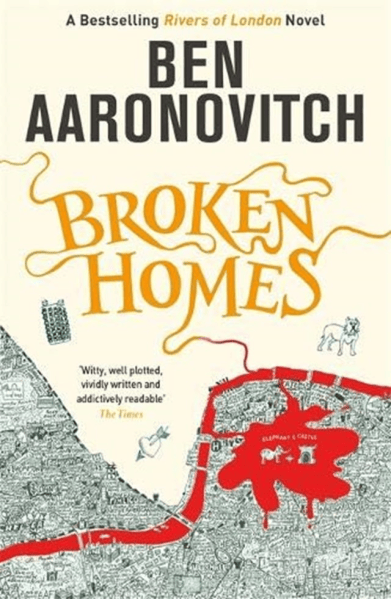
In Broken Homes we also get to see Peter in comparison to others in more direct lighting as a part of the novel itself, not our own evaluation of the characters. We are reminded of the difference between older officers and Peter at a grisly crime scene in a way that is fundamentally different than in the first novel. He paints himself as a bit squeamish in his reports on autopsies, but this time we are looking more on the effect of these experiences on Peter. It’s a nuance that matters.
Since the first novel, our knowledge of the world has grown, the stable of regular characters has grown, and many of them have been given the room to take on more substance, and some to grow. They are familiar, but they also give us connection to a world that is moving around Peter which he might not be inclined to share much about. Such things are not really his story to tell, and he respects the lives and liberties of others intensely.
It’s hard to speak of the profound moments in this book without getting into things better left unspoiled, but suffice it to say that there are descriptions of the natural world and its seasons, there are hints of justice served, there are furious sounds of crime in motion, death visits and revisits, there are arguments about morality and the law, and sometimes there is Nightingale, shooting his cuffs. There is a staircase of duty and fear, and there are horrifying leaps of faith.
If you only ever read two books in the series, I guess I would choose the first and this one.
It’s my gamble that they would drive you to read the rest.
Book 5: Foxglove Summer
This entire novel is set outside of London, but it doesn’t miss a beat. The same sharp characterizations, the same connection between people and their places and things. The lived-in quality of the world and the sense that if you could but close your eyes the right way suggest the memory of the place might rise up like vestigia to fill your senses.
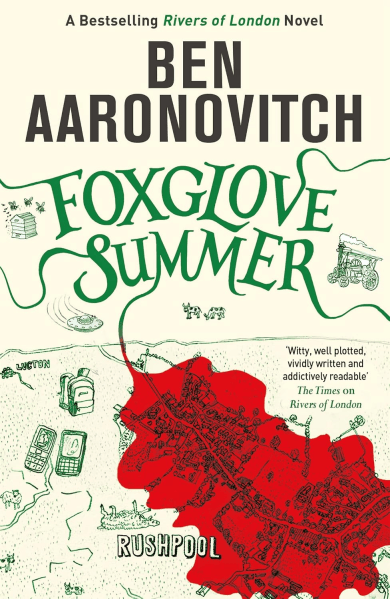
Peter both is and is not a fish out of water in this novel. He is far from his patch, of course, but he is still a police officer serving the community. Challenging for him, however, is that he is – at least at first – tasked with a policing role he has only ever seen done, and which has not really been part of his training. In a case pertaining to two missing girls, Peter initially arrives in the area as a formality to interview a former colleague of Nightingale’s – one of the few surviving wizards from WWII. While there, the stress of the events from the previous book and the urgency of the case hold his attention. He is not needed in the physical search, of course, but having him on hand is seen as a benefit by the local department, so they ask him to take on a liaison role with the families of the missing girls to free up a local officer.
That doesn’t last long, of course. How could it?
This book contributes a lot to increasing our understanding of some concepts and characters we have already gotten to know, while also expanding our understanding of policing in this version of our world, including the Folly’s role within it. These are not the only benefits to this novel, however. It also adds to Peter’s and our understanding of magic and what it can do. These discoveries, or rediscoveries depending on your perspective, come to influence Peter and his investigations significantly in later books, and put some experiences of the earlier books both in sharper focus and in a new context.
For moments of profundity and beauty, we have several potent ones. We have love shown as an effort to free another from pain. We have the curiosity of Peter about his mentor. We have subtle and knowing words about the difficulties of life-long friendships. We have the hesitant fumbling toward admitting to romantic love, and we have the wonder of magic and moonlight. In contrast, both separately and together, we have the sickening fear of being the parents of lost children coupled with the onset of the fear of being hunted.
This book is no joke, as Peter might say.
Book 6: The Hanging Tree
The next novel is no joke either, as its title might imply. Of course, it also hints at the deeper involvement of the Goddess of the Tyburn which once flowed by a most famous place of execution. More than once, Peter has tangled with ‘Lady Ty’ – much to readers’ delight. One of the most significant aspects of their relationship being that each shares at least part of the others’ dream for the future of London and so could be allies, but each rubs the other the wrong way fairly effectively pretty much all of the time.
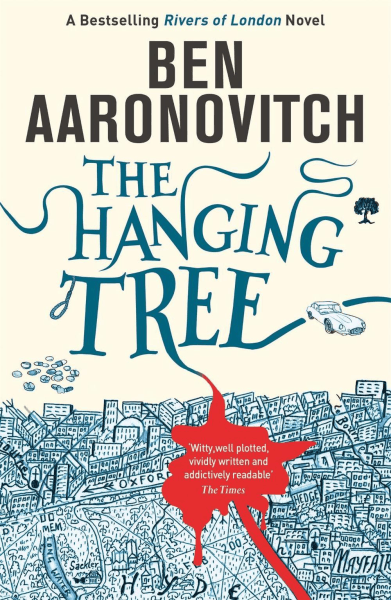
In this novel, the pursuit of the ‘ethically-challenged practitioner’ whose schemes have kept them jumping off and on since the first novel – they they at that time did not know this – suddenly takes on even more urgency. That shift in tempo and tone in the case against the mysterious figure they know only as ‘the faceless man,’ and the murders, attempted murders, and crimes against humanity which are a part of it begin to show the two sides of a commitment to an inhumane goal and very real human weakness.
In the interim since their first encounter with this villain in Soho back in Book 2, the staff and regular liaison officers to the Folly have expanded. More people, particularly but not always non-magical people, are involved. More duties and obligations are stacking up and being added on. More consequence for each risk. More plans to leave unfinished and more words left unsaid. More weight to carry.
The policework in this novel and the look at it from the point of view of the expectations and involvement of powerful people with powerful connections is an excellent addition to the view of policing the series has already given us. Better yet, we see what inroads Peter has made in establishing himself as a part of policing in London. He has earned more trust to counterbalance his reputation for property damage since the early novels. More importantly, however, there are our several potent scenes where the words or the implications or both reward the reader for not passing these books by as ‘just another urban fantasy.’
We have Peter contemplating the motivations of the enemy and his own motivations. We have family ties and debts called in. We have vengeance masquerading as justice, and justice disguised as vengeance. We have old scores to settle, new friends to make, and imbalances to right. We have an older sister taking one last chance to do her part to prevent pain for a younger sister, and spare a foolish wizard from being the source of that pain.
There are also several hints of trouble to come.
Though serious and about serious matters, Peter as narrator manages to keep his wit and quick pacing – though if you listen, you can hear the burden he is staring to carry and hear the creaking of the hanging tree behind him. What he is telling us now is not all that he knows when he tells it, and he is sparing us from it, for a time at least.
Book 7: Lies Sleeping
The final novel for this post is the beautifully titled, Lies Sleeping. This is another high water mark in the series and one of those points around which Peter’s life can be marked as a before and after his whole world changed. The first of these is of course the first novel. Yes, this and one other which shall herein go without being named, have as significant an effect on Peter’s life as him learning that magic is real and he really did take a witness statement from a ghost.
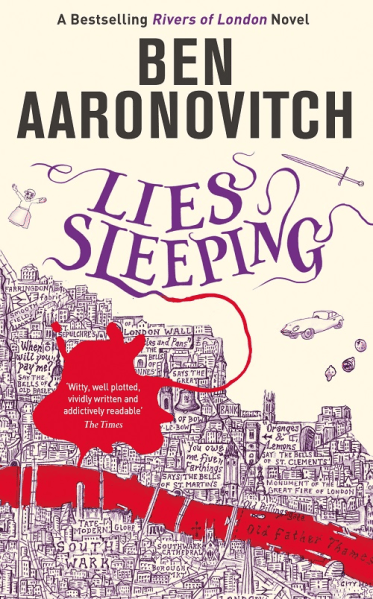
Peter has always been a good listener, but he has also unfortunately been very easy to distract. Things are different now. He has more responsibilities. He has more people to protect and serve. He has a future that could be very bright if he lives to attain it. He has come to know love and has had to face loss. He has had things restored to him, like a relationship with his family, and he has had things taken away – sometimes brutally. Peter is still a good listener, but years of learning how to learn magic. Years of random successes, lucky escapes, and other people facing consequences which seem to pass him by have marked him.
Peter is learning to resist distraction. He, I am certain, will never grow out of the need for someone to say to him, “Peter, focus!” but in this novel we join him in listening to a tale of cruel captivity and fear. We have the choice to imagine it along with him and recognize the truths in it which the fantasy setting allows Aaronvitch to disguise. We have a choice, like Peter, to rise up and attempt to redress that wrong. It’s beautiful in a painful way, and profound in its artful reaching back to much earlier in the series, reaching deeper into the lore Peter barely understands, propelling us forward into action, and most poignant of all – being clear that this is allegory for evils in our own world.
The Game
Taking these four novels together is a healthy slice of a specific period in the life of Peter Grant, and as such that slice has a wealth of detail about the world in which he operates and in which we have been invited to play. We have seen more of how the police operate on a metropolitan, regional, and national level. We have seen typical investigations of thefts, burglaries, kidnapping, and vanishing witnesses. We have liaised with the FBI and that plus the property damage have allowed us to see things like internal investigations and stern talkings to by superiors. While the first set of books set us up to leap into our adventures and cases in this stunning world, this set of four books makes it feel like a much larger and excitingly mysterious world there is room for us to be creative and mysterious in – both as GMs and as players of characters.
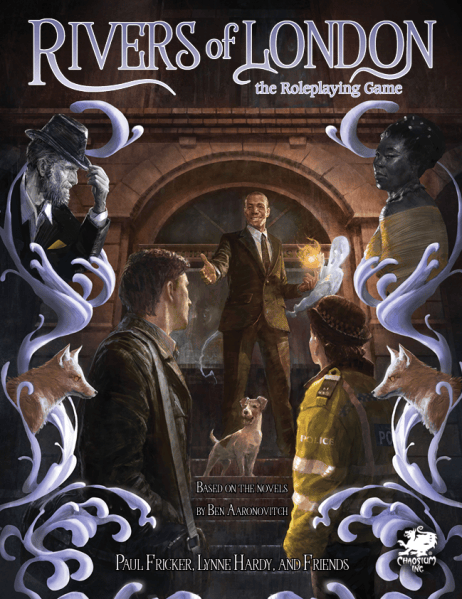
These four books also bring into very sharp focus the notion of luck. Even Peter at this point has to acknowledge some sort of thing working in his favor considering what he has been through and how he has gotten out of it. Likewise, luck is an integral and interesting concept in the game which rather than serving as a buffer versus failure as it might in other games, actively seems like a connection to the spiritual side of the setting in The Rivers of London.
It’s interesting enough to cause more than one person in the books and players in games to decide to pay a little attention to which rivers they cross and what thoughts they send as they do so – you know… just to show willing~
This series of posts?
What this series of posts I hope highlights, is that the alchemical mixture of our own play in the mortar of the books’ moral questions and personal consequences, stirred with the pestle of RPG action and wit, enables us to make the game great when we play it.
Subsequent posts in this series will focus on one or more of the novels, some useful material for gaming in those novels, and a nudge toward and hint about those moments of profundity we talked about throughout each entry.
You can find Part 1 here and Part 2 here. Part 3, unsurprisingly, is here. Part 5 will appear on Sunday, October 4th.
Until then, Dear Reader, take care, and be sure to put a note in your log that we did four books instead of only three. Dr. Walid will want to know~

Part One: Not All Magic and Laughter (or Dice)
Part Two: Riots and Jazz and Sten Guns, Oh My!
Part Three: T’is the Season for Novellas~
Part Five: A Who’s Who of Lurkers, Workers, Hangers-on, and Ne’er-do-wells
Part Six:Rivers of London: Lies, Damnation, and Sudden Vacations


Comments
6 Responses to “Rivers of London: Murder, Brutalism, and Cheeky Nandos”Trackbacks
Check out what others are saying...[…] Rivers of London: Murder, Brutalism, and Cheeky Nandos […]
[…] novels with the special care and nonchalant casualness of a certain Mr. Palmer when lying. In our fourth outing on this subject we returned to the novels and brutally avoided spoilers the way some architects […]
[…] One: Not All Magic and Laughter (or Dice) Part Two: Riots and Jazz and Sten Guns, Oh My!Part Four: Murder, Brutalism, and Cheeky NandosPart Five: A Who’s Who of Lurkers, Workers, Hangers-on, and […]
[…] One: Not All Magic and Laughter (or Dice) Part Three: T’is the Season for Novellas~Part Four: Murder, Brutalism, and Cheeky NandosPart Five: A Who’s Who of Lurkers, Workers, Hangers-on, and […]
[…] Two: Riots and Jazz and Sten Guns, Oh My!Part Three: T’is the Season for Novellas~Part Four: Rivers of London: Murder, Brutalism, and Cheeky NandosPart Five: A Who’s Who of Lurkers, Workers, Hangers-on, and Ne’er-do-wellsPart Six: This […]
[…] Two: Riots and Jazz and Sten Guns, Oh My!Part Three: T’is the Season for Novellas~Part Four: Rivers of London: Murder, Brutalism, and Cheeky NandosPart Five: A Who’s Who of Lurkers, Workers, Hangers-on, and Ne’er-do-wellsPart […]