


Rivers of London: Riots, and Jazz, and Sten Guns, oh my!
This is part two of a series exploring the source material of The Rivers of London roleplaying game by Chaosium which should surprise no one is the Rivers of London book series by Ben Aaronovitch. In part one, we did a ridiculously quick overview of the premise of the series, an even faster overview of the game, and made a note about how the upbeat and humorous writing, punctuated by police procedure and magical action, was also home to beautiful and moving moments of perhaps unexpected potency. In this installment, the first three books are to be brought into the Achieving Best Evidence suite and without benefit of Molly’s cooking, will give up some of the secrets they have been hiding.
Book One: Rivers of London
The first book in the series, written while the author was working at Waterstones and wondering how to keep making ends meet after finishing his time as a screen writer for Doctor Who, is strongly representative of the themes and style which follow. While there are small signs of the universe of the series taking firmer shape in later books, there is a consistency in that universe and the richness of the characters and their relationships which lends it an air of authenticity as a tale told in fond reminiscence of early days.
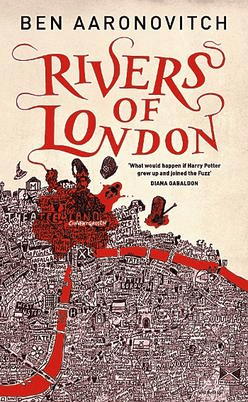
In this novel, Police Constable Peter Grant is introduced to the magical side of life and recruited into the very small department tasked with policing it. Refreshingly, he reacts to all of this with something akin to relief – for many reasons – not the least of which is that a world with magic in it makes things make more sense to him.
This is a novel with investigation; team work, departmental politics played mainly for levity; an exploration of the school ties, informal agreements, and traditions that keep the magical demi-monde in place and in its place; the wonder of the discovery and practice of magic; a hint of romance; and some grisly deaths front and center. It is not trivial violence. It echoes through the series.
Contextualizing everything is London and its long history of human activity, both for good and for ill. Under that, though, is the magic. A fantasy series is frequently judged by and often said to be only as good as its magic. Aaronvitch turns a neat trick of making it sufficiently complex to satisfy readers and keep the characters learning and talking for book after book, but also simple enough that we get it right away and know to respect it.
With all of these things to do, did the author manage to summon up a moment of profoundness? Yes. More than one, in fact. There is surprisingly beautiful language, both eloquent and believable, in Peter’s first use of magic. It is made more potent by its strategic placement in the learning and working montage of the young constable’s daily life. It caught my attention and held it. I jumped back in the audio to listen again and later, when home, I read the text. It sufficiently catches the wonder of magic and its mysterious power for me.
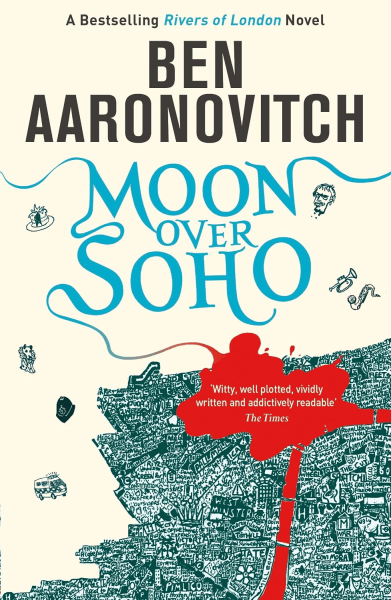
Book 2: Moon Over Soho
There is a thing which happens when a book takes off and the promise of a series becomes important not just to the author, but to the publisher as well. It’s frequent enough to be noticeable and frequent enough to be annoying. Sometimes it ends up making a series better and shifting its direction, of course, but most of the time it tends to make Book 2 feel different than all the others.
In this sort of book, there is a tendency for the amount of sex and graphic description of it to increase regardless of the tone and precedent set by the first book. You can see this happen in the Laundry Files as well. I have no idea if there are thugs working for editors who threaten to break knuckles if the sex to banter ratio does not shift, but somehow it tends to happen. Now, in both of these examples, the author also tried something distinct at the same time and was able to make the inclusion of a disproportionate amount of mating activity figure into their plans, but it still stands out in both series as anomalous.
In Moon Over Soho, Aaronvitch doubles down on his willingness to let you read between the lines and try to view the events Peter relates to us from different perspectives. He doesn’t fill the reader in on what this experience really shows, because Peter is not in a position to do that for him, and in many ways it is better if we get it on our own. There was a time when I would consider skipping this book in a re-read of the series, because it is so different, but there is a magic to it and a haunting sadness which further highlight its moments of nigh-profound profundity. Yes. One of the most personally potent moments in the series and one of its most poignant moments both take place in this book and call me back to the book time and again. Strong visual imagery frames the moments this time more than the language, but the impact is not decreased.
As in the first book, there are moments of extreme violence here, though presented less-graphically, if no less impactfully. There is also a layering of suggested horrors and villainy which prepares us for the books to come and more starkly indicates the upbeat tone Peter takes in his retrospective narration in comparison to the grim experiences that narration covers. Likewise, the tale itself follows the investigation into a barely suspicious death which proves to be right up the alley of the magical arm of the Metropolitan Police Force – the former Gentleman’s Society for the practice of magic in the style of the Newtonian Synthesis, lovingly and disparagingly called, the Folly.
Book 3: Whispers Under Ground
By the time we reach book 3 not much time has passed in Peter’s life compared to that of a reader following along from Book 1, but he has had time to find his feet, enjoy some success, earn some scars – physical and otherwise, and get a reputation for property damage. He has found his place in the world and is actively working to make his world a better one.
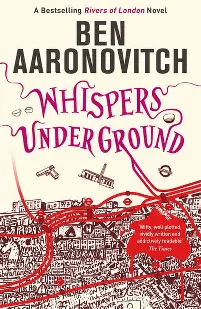
This investigation highlights the author’s willingness to embrace consequences for characters on several levels. The main one of course, is the provisional return of Peter’s friend and potential love-interest from training, still suffering from injuries sustained in the course of the first novel. One of the undercurrents of sadness and responsibility that play a beautiful counterpoint to Peter’s positive and “brave-faced” narration is this friendship and what his reliance on her as a better cop exposed her to and cost her.
Now, in a more equal partnership than the past, the two undertake the investigation into a murder with international impact and potential to really catch media attention given that it does things like prevent subways from running into prime shopping areas in the days before Christmas. Peter is under pressure not just to get the job done, but to get it done quickly and quietly – preferably without damaging any major landmarks or centers of commerce.
A truly fascinating character is introduced in this book who both in text and in audio is a scene-stealer given his loose relationship with the truth and his close personal friendship with wounded self-righteousness. It’s amazing.
This book also has its quieter and more profound moments, sometimes edged with panic and imminent death. The most impactful for me is one which serves as a slow realization of pending death, but there are ones which highlight humanity’s vengeful and competitive, grasping nature which stand out strongly, too.
The Game
Taking these three books together, as I did when I found and started in on the series, forms the basis of how I see the setting in which the game is grounded and sets the expectations for what I expect to do with it. The investigations and their consequences covered in this set of books underpins and explains the future personnel expansion of the Folly which frames the character options and point of view for the game’s core rules. While in play we cannot emulate the perspective of the books, told as they are from an unknown point in the future, we have tools in the rules and in the source material to ground us in the present of the past being related, mainly by Peter.
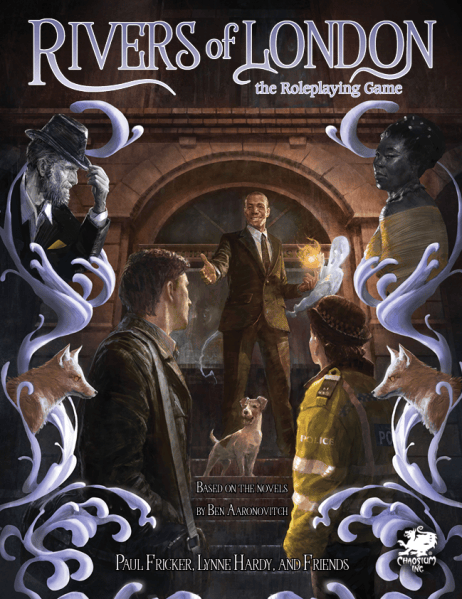
A game of Rivers of London would be good with an interesting investigation, particularly one which builds on the solid police procedural material included in the core book. The game would be good with some interesting magical challenges or diplomatic struggles with members of the demi-monde. The game would be good with some fun buddy-cop action to handle some villains. It will be better if it manages to blend threads of some or all of these – not always clearly or of immediate import – most of the time. From time to time, to seal the deal, moments of real introspection about the nature of social force and the role of force of various types in society, particularly in terms of our personal use of it, would nudge play of the game from one of many fun ones toward the fewer particularly memorable ones.
A game will have a Rivers of London flavor if there are strong opinions about architecture, off-handed comments about legal precedent and zoning, and a running commentary about traffic. It will have a special familiar zing if there are assessments of property value for various reasons, before and after any accidental demolitions have taken place. Humorous handling of desperate situations, such as the inadvertent creation of a sport (with or without biohazards), is also a telling note to add.
A game will find some of its tone and flair in the relationships the characters bring with them from conception and the ones they develop in play. A game with a mixture of professional colleagues and personal contacts and relatives will be good. The interactions in the books between characters and because of the character of those characters is a defining element in what makes them immersive and affecting reads. There are, as in life, few easy relationships but each adds its thread to a growing tapestry of people who come over time to see themselves, and to be seen, as part of a whole, not just one more faceless soul falling into a hole.
A game will find some of its wonder and no small part of its mysteries in the denizens of the demi-monde, but there are more wonders than these. A game with an awareness of how strange London and the world can be, which also remembers that much of that strangeness comes with human faces, will be good. If it can also remember that some of it tears human faces off or can kill life and memory with a touch is good, too. The cases in the series are often very human ones, albeit with proximity to or causes in the “supernatural.” There are murders, some of which are by magical means. There are hauntings and possessions, there are domestic rows, and there are plots big and small. There is destruction and loss put in contrast with creation and discovery. Through it all is the erosive and perhaps corrosive effect of secrecy and isolation on those who see themselves as necessarily separate and in the shadowy fabric of society which helps shape and secure it. There is wonder in the sacrifices revealed in this magical world which reflect very real ones in our battered mundane one.
The Rivers of London series is full of a delicious blend of all of these. Each book is familiar, yet distinct – which is no easy task. The task given to those who labored to produce a lovely game from the series, and for we who run and play it, is to take all these ingredients and make them accessible, not as a recipe for a fine stew we seek to return to time and again, but as the staples which make up the look, feel, and spirit of a place we visit; a place where our visits matter. It’s easier than you might think, if you put your heart into it.
What this series of posts I hope highlights is that the mixture of these essentials with the alchemical reagent of allowing ourselves to open heart and mind to the wonder and import of Rivers of London, with all of its moral questions and personal consequences creatively and carefully simmered with the action and wit gamers have been discovering in themselves since the hobby began, allows us to make the game great when we play it.
This series of posts?
Subsequent posts in this series will focus on one or more of the novels, some useful material for gaming in those novels, and a nudge toward and hint about those moments of profundity we talked about throughout this entry.
You can find Part 1 here. Part 3 will appear on Sunday, September 20th.
Until then, Dear Reader, take care~


 Casting Shadows