


Rivers of London: Lies, Damnation, and Sudden Vacations
This is part six of a series sharing thoughts on the source material from The Rivers of London novels by Ben Aaronovitch which might encourage some intentional or accidental profundity in the play of the stylish and charming RPG of the same name from Chaosium. This series explores inspirations for and attitudes about playing the game, to support those gamers who look past the expectations of typical urban fantasy and police procedurals (or who want to) in finding the semi-secret moments of insight and empathy which lend this series its weight. If it also entices readers not yet acquainted with roleplaying games, or entices them back to them, that would be a nice perk as well – although if you can resist the urge during a reading of False Value I doubt anything that I might write would sway you. At any rate, links to the previous installments of this series can be found neatly arrayed at the end of this post, and there is nothing for us to do now but settle in for this next egregiously surface-level scan of the most varied and divergent books in the entire line to date. Ready?
Books 8-10 + 1 to grow on:
At this point in any series, there is a certain pressure and expectation to refine and revert to a formula. Fortunately, the character voices in the author’s head are too insistent for that to have happened, yet. Hopefully, it never will. Aaronovitch has a refreshing willingness to let the world change as it will, to let chips fall where they may, and to enable us to grow along with it as it inexorably expands in scope.
In the four books which are the subject of this post, this variation and growth is the most evident. Don’t worry about covering four books again, Dear Reader. You should still log your time, but you won’t concern Dr. Walid as much as last time. One of the books is not even a novel. Your odds of overdoing the magic and winding up in the ICU are minor, at best.
No, really.
It’s fine.
Honest!
Book 8: False Value
In this fascinating entry into the series we learn many, many things, not the least of which is that Ben Aaronovitch and I (and perhaps you, too) have a history of playing the same games. A lot of them get name-dropped in this book and some of those mentions are real laugh-out-loud moments. There are lots of reasons for me to return to this novel repeatedly. This shared gamer perspective is often sufficient to get me to open the book and start reading all on its own, but there are other draws at least that significant, too.
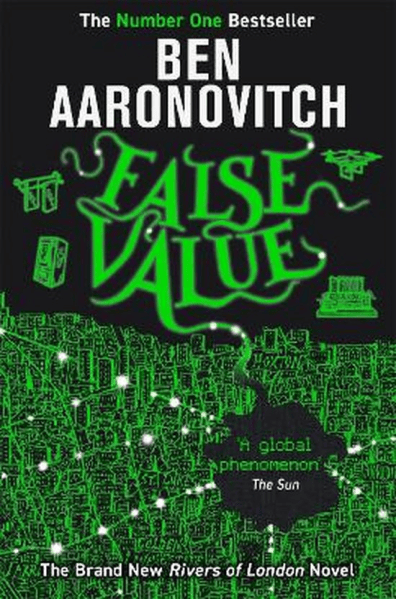
In False Value, the reader is hit with a tidal bore of changes, seemingly altogether and without warning. Departing from the usual structure of the novels, this one is presented to us with an eccentric approach to the flow of time very becoming of a former Dr. Who script writer. This in a fairly real sense, restores to us to a refreshing level of naivete about what to expect. There are things we understand, of course, but the circumstances which land us in the opening stages of the novel are temporarily obscured and that is interesting! Especially as the present and the past are doled out in a fun mixture of large and small bites with Peter always in the know about the tale he is telling, and working hard to keep us guessing.
It isn’t just the format which changes. While still a mystery, this novel plays with direction and misdirection in new ways, introduced new players and entirely new consequences, upends some comfortable assumptions, and hits Peter right in his most vulnerable spot. No, not his ego – his morality. His mortality is hit as well, and in ways we have reason to fear might not turn out so well for him. His ego takes a pounding, too, but that should not be a surprise. Not everything can be changed.
All the major players are present, but everyone is involved in very different ways than usual. Also, during the series we often have several competing storylines happening in and around each other, sometimes just simultaneously and sometimes connected in ways which are not obvious at the beginning. Usually, while the fallout and consequences tend to find Peter one way or another, the sources remain separate. In this novel, however, it’s of note that the consequences tend to give Peter a miss, and tend to have a singular source. It’s a stark change which hints at some of the darker tones the older Peter in the earlier narrations had earned.
Further, just to hopefully set the hook deeper, a mystery suggested at earlier points in the series comes home to roost in this one and it’s a beauty.
With all of this going on, did the author’s muse find a way to instill that sense of wonder and beauty that mark the other entries in the series?
Yes. I should say, though, that these, too, are different.
We see uneasy acts of contrition and difficult acts of forgiveness. We see the fragile loveliness of the world reflected in the slick face of horror. We see panic reaching out for help and to protect with brutal result. We also, in a nuanced way, rub shoulders with the insight that history is a lie even when told by the well-intentioned, and our perspective on a thing obscures as much if not more than it reveals.
Heady stuff~
Book ~: Tales from the Folly
This is not a novel, but rather a collection of short stories which started life as an obligation to the publisher and then took on a willing and willful life of their own. For this we should be grateful as there are gems in here. At least one such gem, if read before the tenth novel, Stone & Sky, will make that book all the sweeter.
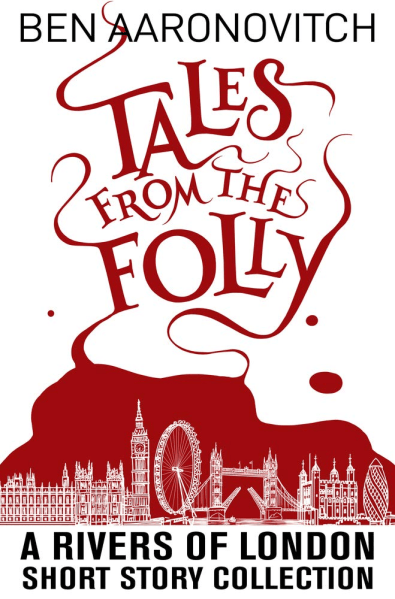
This book does not stand out just because it is not a novel at all, but also because it gives us stories from other perspectives than Peter’s, and quite a few of them, in fact. We get a truly poignant return to the perspective of his cousin Abigail, of course, and if you are looking for a moment of profundity in this book, this is the obvious one. Still, even the more unusual tales have them. For example, we also get the point-of-view of a member of the criminal element (who gives further shape and color to the vision of Soho in the past presented in Moon Over Soho). We get another look at how baby Rivers find their homes – this time the Lug, not the Chester. We even get short and separate moments with Nightingale, our two German representatives of magical policing, and our pet FBI agent. We also find sports, radical changes in occupation and personal identity, another practical use for Peter’s architectural knowledge, a look at abduction(s) both willing and not, and an early version of technological hijinks. There is also a strong message about reading.
It’s quite a list!
If not read for the simple pleasure of it, this is a good one to recommend to expand the reader’s view of the setting and all the strangeness within it. Tales from the Folly is a good one to be read on its own when you want a taste of the magic, but are trying not to relaunch another spree of reading them all again. It can satisfy the urge – for a time.
Interestingly, throughout the book there is a recurring theme of loneliness which tries at times to hide, but it’s there. Even in the earlier shorts stories which seek to be funny lures to try to the series, that theme is there. Just ask the junior aide for the French Olympic team.
Book 9: Amongst our Weapons
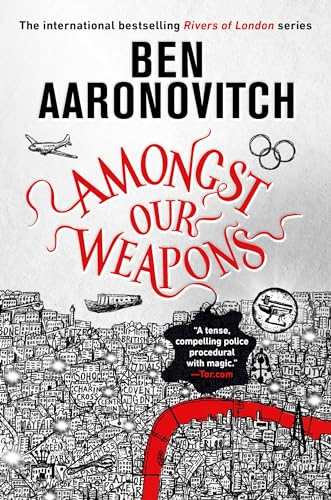
This novel is both ironically and unironically unexpected, but I will annoyingly leave that observation in the IYKYK column. Please accept my vague apologies.
Moving on.
You may remember that in Moon Over Soho, there was an image of such profundity that it caught me off-guard and is often the first image I ever have of this series when it comes to mind. In my non-spoiler way, it’s a moment of understanding between Peter and Nightingale as they discuss a particular use of woodworking. As a whole generation we perhaps did not get the chance to know better sinks out of view behind us in the fog and falsehoods of fading memory, you might remember the moment I mean.
Until this book, not at all one of my favorites and perhaps only slightly higher in my estimation than the second novel, I did not think another moment in the series would come near to it, let alone match it. I was, of course, quite wrong. As with Moon Over Soho, that moment drags me back into Amongst Our Weapons time and again and it hits me as hard every time.
Again, in my non-spoiler way, this moment is a point of decision for Peter and it is agonizing for him. As he wrestles with it, a conversation in the kitchen turns from expected dialogue to the sublime. It hits hard both in print and in the voice stylings of the esteemed narrator, Kobna Holdbrook-Smith. It is a moment of pain, of love, the pain that love brings, and the fear as well. The cycle of life, of friendship, of hope, of love, of loss, and of duty is present in that short scene in the kitchen and it, for me at least, is a, if not the, major milestone on the journey from the first book to where we are now in the ninth. “No,” this scene says. “Find another way.” The reasons for that plea, and the response it has in Peter are profundity enough for any novel, but this book has more.
It has moments of remembered quiet in a river barge. It has respect hard won. It has the bonds between mentor and student, and it has slavery and sacrifice.
I suppose, for those who are into that sort of thing, it also has floaters.
IYKYK.
As usual, the book has much more to offer and its expansion of our understanding of the world is significant. Excluding all the revelations of the first book, we haven’t seen its like since Whispers Under Ground and perhaps Foxglove Summer. To be clear, False Value claims to be in this crew of world expanders, but it cannot hang with these novels, as significant as it is. We won’t see anything like this again until… well, the next book.
Book 10: Stone and Sky
The current “most recent” novel in the series, for now at least, is another radical departure from the form one might expect. Stone & Sky has not just Peter’s point-of-view retrospective narration, it also has Abigail’s in-the-moment diary approach to relating what she had been getting up to at that time. She first pops in for Chapter 4 of the novel, adding the voice stylings of Shvorne Marks to the series regular Kobna Holdbrook-Smith, and her first line is a gut-punch. Abigail is a tough kid who doesn’t mess about, but who has been messed about quite a bit by life, if you pay attention to what isn’t fully said. This time, though, there is no equivocation. She pulls no part of this punch. It’s enough to make you flinch.
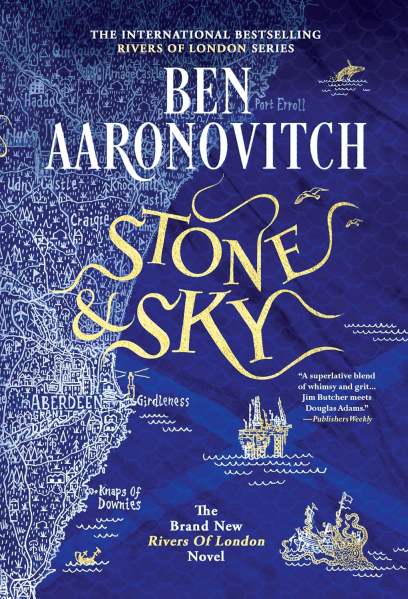
In this novel, we once again leave London, but holy hell we drag quite an entourage along with us! For our convoy of protagonist and protagonist-adjacent characters who make the trip from London to Aberdeen, this is mainly a vacation. However, since when has a vacation stopped the advent of a mystery? Vacations practically beg for mysteries, don’t they? Whatever your answer to that question, however, Peter would like it to be on record that none of what happens in this novel was his fault.
Stone & Sky is atypical in other ways, too, but I will let you discover how on your own. This novel is a good example of a police investigation into some very weird bollocks, but with a few years of the revitalized and modernized Folly behind it. It makes a good comparison to the reception Peter gets in Foxglove Summer, for example. I am not, of course, saying he gets greeted with open arms, but considering how far he is from his ‘patch’ we can see some progress. Further, Peter is growing more comfortable with the idea of leadership.
Where this tale goes is mythical and magical as one might hope for given the location and the title and I do not want to say too much about it. Those who were following along with the graphic novels at the same time were given a bit of a sneak preview of what could happen in this novel, but even if you do not follow them, Peter is always ready to catch us up with hints about what we have missed and just the right amount of specific detail to not get lost.
Avoiding spoilers, what I will say about this is that we have not seen so significant an expansion of the world since Amongst Our Weapons, the previous book. Really, though, to be fair, we have not seen an expansion like this since Whispers Under Ground.
It’s significant, and then some.
The Game
Taking these four books together we are dealt a pretty wild hand of cards to change things up with. Each brings something new to the table and each is utterly fearless in how they push at the boundaries of the world we have come to know over the previous seven novels and associated novellas, short stories, and graphic novels.
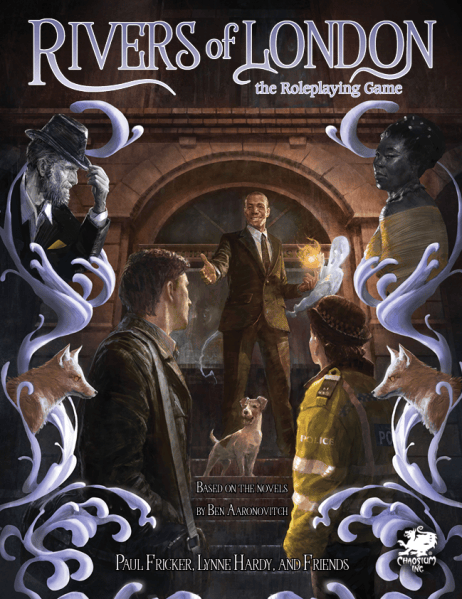
False Value is the ostensible opening point for play in the core book (see p12). With all the changes which mark that novel, it is fitting that one of the other major changes it heralds is the opening of the Folly to more officers, associates, and contacts and thus paves the way for our characters and their case files. I am not sure that the events of that novel would be the sort of thing that Peter and Nightingale would discuss with new recruits, so it isn’t on my must-read list for the purpose of playing the game, but for the wily GM who wants to shoot for as much depth in the campaign as they can muster, the novel is essential.
Amongst Our Weapons shows us an investigation as violent as it is mysterious. The death toll is quite significant and gory, even by the standards of this series, plus the visuals and metaphysics are rich areas for speculation and roleplay. The events of this novel are not as easily kept under wraps by Peter and Nightingale, and it would be the sort of thing that would fascinate those associated with the Folly – especially considering some of the more dramatic outcomes… say the roof, for example.
Stone & Sky again gives us more of a look at the Peter our characters might be growing to know. Still charming and still funny, but a father now and fitting more comfortably into the professional role he may have been destined for. He has learned a lot, but is still very hungry to learn more. More importantly, he is just as keen to share as to learn. That is good, for the world keeps getting wider, stranger, and more magical all around us, wherever we look.
These four books are not the books that started us on the journey, they are instead the books which help to launch us on our own journeys into lands both explored by the novels and untouched in them, so far. They are our call to let slip the hounds of imagination and begin our own hunt for magic, love, family, friendship, PACE compliance, and community outreach in a world as full of loss, pain, laughter, and hope as our own.
This series of posts?
This series of posts is now “complete.” I will not be launching an expedition into the graphic novels, as grand as they might be. I hope someone else out there will take that project on. I will consider adding another post to this series after the author has provided three more novels for us to be vague and mostly opaque in describing. By then the game should be even more well-established with an even greater variety of support materials to draw from as needed. The core rules and the novels give us a wonderful foundation to build upon and play within. Where will our creativity and imagination take us?
What I hope this series has helped to highlight is that our play in the author’s world of colors both dark and bright with Chaosium’s system to keep us honest and inspired is a form of magic all its own – and it is no mere folly at all.
Thank you for joining me for this series, Dear Reader. I hope you will come to visit to see what posts on which RPG subjects come next. In the interim, take care, and be sure to check twice for Molly before putting your unfinished meal on the floor for Toby.
Part One: Not All Magic and Laughter (or Dice)
Part Two: Riots and Jazz and Sten Guns, Oh My!
Part Three: T’is the Season for Novellas~
Part Four: Rivers of London: Murder, Brutalism, and Cheeky Nandos
Part Five: A Who’s Who of Lurkers, Workers, Hangers-on, and Ne’er-do-wells
Part Six: This magnificent feast here represents the last of the petty cash~


Comments
5 Responses to “Rivers of London: Lies, Damnation, and Sudden Vacations”Trackbacks
Check out what others are saying...[…] Part Two: Riots and Jazz and Sten Guns, Oh My!Part Three: T’is the Season for Novellas~Part Four: Rivers of London: Murder, Brutalism, and Cheeky NandosPart Five: A Who’s Who of Lurkers, Workers, Hangers-on, and Ne’er-do-wellsPart Six:Rivers of London: Lies, Damnation, and Sudden Vacations […]
[…] Part One: Not All Magic and Laughter (or Dice) Part Three: T’is the Season for Novellas~Part Four: Rivers of London: Murder, Brutalism, and Cheeky NandosPart Five: A Who’s Who of Lurkers, Workers, Hangers-on, and Ne’er-do-wellsPart Six:Rivers of London: Lies, Damnation, and Sudden Vacations […]
[…] Part One: Not All Magic and Laughter (or Dice) Part Two: Riots and Jazz and Sten Guns, Oh My!Part Four: Rivers of London: Murder, Brutalism, and Cheeky NandosPart Five: A Who’s Who of Lurkers, Workers, Hangers-on, and Ne’er-do-wellsPart Six:Rivers of London: Lies, Damnation, and Sudden Vacations […]
[…] Part One: Not All Magic and Laughter (or Dice) Part Two: Riots and Jazz and Sten Guns, Oh My!Part Three: T’is the Season for Novellas~Part Five: A Who’s Who of Lurkers, Workers, Hangers-on, and Ne’er-do-wellsPart Six:Rivers of London: Lies, Damnation, and Sudden Vacations […]
[…] Part One: Not All Magic and Laughter (or Dice) Part Two: Riots and Jazz and Sten Guns, Oh My!Part Three: T’is the Season for Novellas~Part Four: Rivers of London: Murder, Brutalism, and Cheeky NandosPart Six:Rivers of London: Lies, Damnation, and Sudden Vacations […]